
The Dark & Dangerous Thrillers Collection
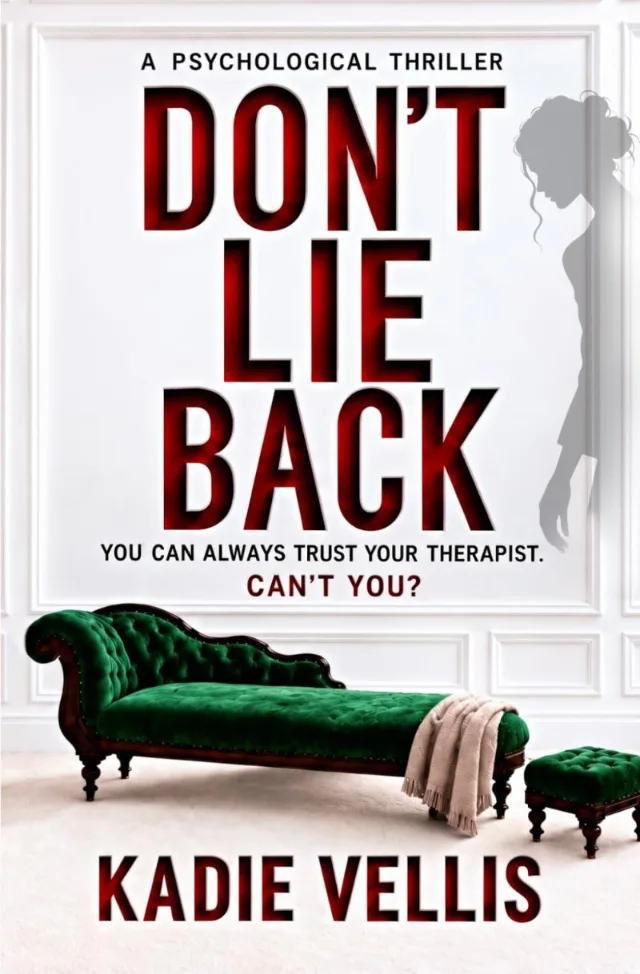
Don’t Lie Back
You can always trust your therapist. Can’t you?
Nicole can tell within minutes whether a woman is really ready to leave. She’s built a whole career helping women walk away from men who control them, and she’s got the perfect husband to prove she knows what a good one looks like. Then a new client starts describing her partner. The way he talks. The things he does. And he sounds an awful lot like Luke.
Inside the story
You can always trust your therapist. Can’t you?
Nicole is a therapist who helps women leave the men who control them. She can tell within minutes whether a woman is serious about leaving. She has a gorgeous husband, a beautiful practice and a green velvet chaise where her clients lie back and tell her everything.
Then a new client starts describing her partner, and the details sound far too familiar.
Every session pulls another secret into the room, and somewhere in all of it, someone is keeping a diary.
Funny, threatening and impossible to put down, with an ending that will make you gasp.
Chapter One
Read the first chapter
A green velvet chaise longue above a dentist on Upper Street, a client who keeps making excuses, and a therapist who notices everything.
Or read it on this page
I can tell within minutes whether a woman is serious about leaving, or if she just wants to make more excuses to stay.
Shannon had been making excuses for eight months. That Tuesday she spent the session twisting the ring on her finger, round and round, as if she could unscrew it and leave it on my coffee table.
“He’s not like that all the time,” she said. “Sorry. I know I keep saying that.”
“I know.”
“He’s actually really sweet. He did my mum’s guttering on Sunday. In the rain.” She laughed, a small hopeless sound. “Who does guttering in the rain?”
A man who wants your mother on his side, I thought. I didn’t say it. You can’t hand people conclusions. They drop them. They have to find them on the floor and pick them up themselves, and that can take months, and some women would rather step over them for years than bend down.
She was sitting on the very front edge of the chaise, which is where most people sit the first few months.
I bought it at an auction in Lewes the year I set up on my own, and I’ve never regretted a penny. It’s a proper Victorian chaise longue, deep green velvet gone soft and pale along the seat where a hundred and fifty years of people have sat on it, with a scrolled arm at one end that you can lean back against and a low buttoned back that runs half its length and then gives up.
It came with a footstool in the same green, square and squat on four turned legs, which I keep a little way off from it, so that nobody has to use it and everybody has to decide. Some people pull it in with their heel in the first five minutes and put their feet up as if they’ve come home. Some push it away with a toe. Some don’t notice it for a year. I tell every new client the same thing: sit up, or lie back, whatever feels right. Hardly anybody lies back.
Shannon had never touched the footstool. She kept her feet together on the rug in front of it, like a girl waiting outside the head’s office.
My room is on the second floor of a Georgian house on Upper Street in Islington, above a dentist who plays Classic FM all day, so every confession up here comes with strings. I once had a man admit to a second family over the Dambusters March. The box of tissues sits on the little table at an angle, one tissue already pulled halfway out so nobody has to ask. People notice that sort of thing without knowing they’ve noticed.
Shannon had used four tissues. She was thirty, a primary school teacher, the kind of woman who brings her own pen to appointments and apologises to the furniture if she knocks it. She was small and mousy, with her hair in a ponytail she redid whenever she ran out of things to say, and nails bitten down so far they looked sore.
She’d grown up in Walthamstow and her voice went more East London the more upset she got, and she said sorry more often than she said anything else. When she first came to me it was about stress at work, an Ofsted inspection and a head teacher who sent emails at midnight. Over the weeks, her boyfriend had crept into every sentence, like damp up a wall.
That afternoon she’d brought something with her. She took it out of her handbag and held it in her lap for a while before she passed it over: a small red notebook, the kind you buy in packs of three at Ryman’s.
“Ryan doesn’t know I’ve got this,” she said.
Every page was filled with tiny, careful handwriting. Don’t hum when he’s reading. Don’t say “literally”. Sandwiches cut straight across, never triangles. Don’t mention Lauren’s new flat. Don’t ask how his day was until he’s had a shower. Pages and pages of it, some lines crossed out and rewritten, some underlined twice. Towards the back the writing got smaller, as if she’d been trying to save paper.
“It’s so I don’t forget,” she said. “If I remember everything, it’s fine. It’s only when I forget.”
I turned another page. February. Don’t text Kirsty at the table. EVER.
“Tell me about February again.”
She looked at the window. “It was literally twenty minutes. Honestly, Nicole, twenty minutes, tops.”
“On the balcony.”
“I’d been texting my sister at dinner, and he’d asked me not to, because it’s rude, which it is, and he went out for a smoke and I went out to apologise, and he came back in and he locked it. As a joke.” She pulled the sleeves of her cardigan down over her hands. “He thought I had my phone. I didn’t. That’s the only reason I was out there that long.”
“What was the temperature that night?”
“I don’t know.”
“Roughly.”
“It was February,” she said, and her chin went. “I had socks on. Just socks. I remember thinking if I stood on one foot at a time I’d only lose half as much.”
I let it sit. Silence does most of my work for me.
“What did you do,” I asked eventually, “to make it up to him afterwards?”
She opened her mouth to say she hadn’t done anything. I watched her realise. It’s a remarkable thing to see, a thought arriving in someone’s face, and I’ve never got tired of it.
“I bought him some trainers,” she said. “The ones he’d wanted.”
“After he locked you outside.”
“He was upset. He said I’d humiliated him at the table.” She pressed the heels of her hands into her eyes. “You make him sound like a monster. You don’t know what it’s like, living with someone and loving ’em and being scared of getting it wrong.”
I did, as it happens.
I was married to a man called Simon for six years, and by the end of it I couldn’t choose a sandwich in Pret without checking his face first. He chose my friends by making the wrong ones feel unwelcome, and my clothes by going cold when I wore the wrong ones, and he did all of it so pleasantly that for years I thought the problem was me.
I was a counsellor even then, a junior one, doing six week contracts on exam stress and bereavement in a GP surgery in Kentish Town, and I sat in that little room every day telling other people they deserved better while I went home and asked permission to open a window. When he died, I went back and trained again, from the beginning, in the thing that had happened to me. Everything I do now, I learned at his kitchen table first. The qualifications came afterwards.
Simon has been dead for nine years. There are still mornings when I wake up and reach across to check his side of the bed for his mood, before I remember it’s Luke lying there, warm and snoring, with one foot out of the duvet, and that I’m allowed to breathe.
I don’t tell clients any of that. It isn’t theirs to carry.
“I haven’t said a single word about him, Shannon,” I said. “Everything I know about Ryan, you’ve told me.”
“You don’t know him.”
“No. I don’t know Ryan. I know a trauma bond when I see one, though.”
She stared at me, and I explained it to her gently, as I’ve explained it to more women than I could count. That the hurt and the kindness come from the same hands, so the body learns to wait for the kindness. That the relief when he’s sweet again is so huge, the body mistakes it for love. That this is why she couldn’t leave, and why it had nothing to do with how clever she was.
“You can lie back, if you like,” I said. “Nobody’s marking you.”
She looked down at the long green seat beside her, and the scrolled arm, as if I’d suggested she get into a stranger’s bed.
“If I lie back,” she said, “I’ll never get up.”
She listened. She cried. At ten to six she took her red notebook back, said she’d book in for next week, and hugged me at the door, which clients aren’t supposed to do and always do.
She wouldn’t book. I knew that before she reached the stairs. I wrote my notes, client minimising, risk escalating, likely to disengage, and made a small private mark in the margin, which is how I keep count of the ones who go back. Shannon was the fourth this year.
Of the three before her, one had rung me in the spring from a refuge in Leeds, to say thank you. I never heard from the second again. The third I read about in the Evening Standard, on a Tuesday in March, on the 19 bus, in a paragraph at the bottom of page eleven that didn’t give her name.
On the walk home I rang Bea, because Bea had been on a date the night before with a man from an app whose profile said he was fluent in sarcasm, and I needed to know how it had gone.
“Seventy minutes, babe,” she said, before I’d even said hello. “Seventy minutes on his ex. I timed it on my phone under the table. Her name’s Jade, she does Pilates, she’s got a dog called Bruno who apparently was the real victim in all this. I know Bruno’s star sign, Nicole. Bruno’s a Leo.”
“Did he ask you anything at all?”
“He asked if I was going to finish my olives. I said yes. Then he ate them while I was in the loo and at the end he got his calculator out to split the bill by what we’d each had, and he charged me for half of them.” Her voice went up an octave. “I didn’t have any olives. I had the idea of olives. He charged me for the idea of olives.”
Bea has lived in London for twenty years and still sounds fresh off the train from Chelmsford, fast and loud, every story told at the volume of a woman calling her kids in off the street. I laughed so hard at the lights on Upper Street that a man in a suit stepped away from me.
“Tell me again why I can’t find a Luke,” she said.
“Because there’s only one, and I got there first.”
She made a noise like a goose being sat on and hung up on me.
The house smelt of garlic and rosemary when I let myself in, and there was music coming from the kitchen, and a man in an apron getting all the words wrong with total confidence. I stood in the hall with my coat still on and listened for a minute. I do that sometimes. Seven years on, I still can’t quite believe it’s mine.
He came out to find me with a wooden spoon in his hand, ducking under the kitchen doorframe out of habit. Luke is six foot three, an old rugby player gone soft round the middle, with sandy hair thinning at the crown and brown eyes that disappear when he laughs, and there’s nearly always a pencil behind his ear that he’s forgotten about.
“There she is,” he said, in the Southgate voice he’s never bothered to polish. “Dinner in half an hour, love. Sit down before you fall down.”
He’d laid the table already. Two candles, because it was Tuesday, and on my side, propped against my glass, a page torn from his sketchbook with a drawing of me on the phone at the lights on Upper Street, laughing, with a little man in a suit leaping away from me in terror.
“How do you know about the man in the suit?”
“I didn’t.” He looked pleased with himself. “I just know what you look like when Bea’s had a date.”
At twenty to eleven, while Luke washed the roasting tin, an email came into the practice inbox. I read it on the sofa with my feet tucked under me.
Dear Nicole, I’m sorry to write so late. I need to talk to someone about my partner. I’ve read everything you’ve written about coercive control, and I think you’re the only person who’ll see what I see. Please don’t pass me on to anyone else. I’ll wait as long as I need to. Jess.
No surname. No phone number. A Gmail address made up of her first name and a string of numbers.
I’ll admit I was flattered. You spend nine years writing articles nobody seems to read, and then one evening a stranger tells you that you’re the only person who’ll understand. I replied that I had a cancellation on Thursday at six.
Her answer arrived inside a minute.
Thank you. You’re the only one who can help him.
Seconds later, another one.
Sorry. Me. Help me. I’m so tired I can’t even type.
Tired people make mistakes, I told myself, and I was about to put my phone away when a third email came through.
Please don’t tell anybody I’ve been in touch. Not your family, not your partner, not your friends. Please don’t tell anybody.
I looked up. Luke was at the sink with his sleeves pushed up, singing to the radio again, a song about a girl from Ipanema whom he seemed to think lived in Ipswich.
Frightened clients have written to me before, plenty of them. They’re terrified their partner will find out, or their mother, or someone at work. In nine years, nobody had ever been frightened of who I might tell.
DATE ____________
Entry one
Someone I trust told me to start writing things down, because I can’t always tell what’s real any more. She said I didn’t need to use names. It’s easier without them. So this is me, writing it down.
I’m not allowed to wear the grey jumper. It was never a rule. I wore it once and the whole evening went cold, and nobody said why, and the next morning it had gone from the drawer. Months later I found it at the back of the airing cupboard with both sleeves cut off. Neither of us has mentioned it.
I’m writing that one first because it sounds so small. If I can’t explain a jumper, I don’t know how I’ll explain the rest.
Everyone tells me I married the kindest person they’ve ever met. I tell them they’re right. I want that written down too, in case anyone reads this one day and thinks I’m stupid.
What readers are saying
What an ending
“If you love a thriller you will LOVE this book. I cannot recommend enough”
“Wow!! What an ending!!!”
Real reader reviews from Amazon UK, shortened.
Perfect for fans of
If you love these, you’ll love Don’t Lie Back
The therapy room
The green velvet chaise
Every client who comes to Nicole lies back on the same green velvet chaise, with its matching footstool and a grey throw over the end. Some use the footstool. Some don’t. Nicole notices everything.
Questions
Don’t Lie Back questions answered
What is Don’t Lie Back about?
A therapist who specialises in coercive control, a new client whose story hits far too close to home, and a marriage that looks perfect.
Does it deal with coercive control?
Yes. It’s at the heart of the book, explored through Nicole’s clients and their stories.
Is there a twist?
Yes, and readers say the ending left them speechless.
Is it a standalone?
Yes.
Who will enjoy it?
Fans of Freida McFadden and Lisa Jewell, and anyone who has ever wondered what their therapist really thinks.
How long is Don’t Lie Back?
321 pages.
Watch the trailer
If this one gets under your skin


Kadie Vellis
Be the first to know.
New releases, cover reveals and the odd secret, straight to your inbox.
Join the readers’ list